
We all do it. Every week. Or more often. (Twice one day, anyone?) The trip to the grocery store is necessary for someone if the family will be eating meals in the future. If you do not have a personal shopper or an online grocery ordering service in your area, this post is for you.
The first step in organization for grocery shopping is fairly obvious: a list. Any list. You may have a notepad in the kitchen where you jot down staples as they occur to you or you run out. That’s a good start. If you are a smart phone user, you can use an app like GroceryIQ to keep track of what you need beforehand and what you have in the cart while you shop. If you do regular meal planning, a shopping list comes out of that effort as well.
However it looks, knowing what you need before you head to the store helps save time thinking about it in the aisles (or a second trip for forgotten items) and helps limit the impulse shopping.
May I suggest an improvement on the basic list? You can save a significant amount of time by planning out your list and your path each trip to get you in and out of the store efficiently. With an initial investment of time, you can design a list that works for you and your preferred store(s).
- Head to the grocery store with a pad and paper (or take photos of the aisles and type it up at home). Note each aisle in the center of the store in order, along with the categories of food in them. Then make a list of the outer walls (i.e., produce, deli, bakery, dairy, frozen) in order with frozen at the farthest end. The goal is to start at one end of the center aisles, finish on one side of the store and then walk the edge all the way to the checkout, with ice cream being picked up at the last possible moment without losing the flow. Note: if freezers are in center aisles, start the list at the other side of the store, then do the outer edge as described after the aisles finish in Frozen Foods.
- At home, type up your list. Each aisle would be a separate section. After you list the main categories, add in items that you buy regularly, such as Raisin Bran, cheddar cheese, rice. List them in the section in the order they come in the aisle.
- At the end of each section, add at least a couple extra lines to write items in.
- Format the list in columns (to be easier to read) and to fit on the front and back of one sheet of paper. Depending on your store and volume, you may be able to fit two lists on one sheet and save paper.
- Print and have handy in the kitchen. As you need items, circle them. You can note how many you need in the circle. You can write in special items in the proper section. When you are ready to go to the store, your list is ready and organized to go with you. Print more lists as needed or revise and print when the store remodels.

When you are at the store, you can walk through the list, aisle by aisle. Pick items up in order down the row. Don’t leave the aisle without a quick check to make sure you have all you needed. You can skip aisles where you have nothing marked — or walk quickly through to get a few more steps in on the Fitbit. Once the shelf-stable items are in the cart, take your final lap around the edge of the store and head to the registers. Voila!

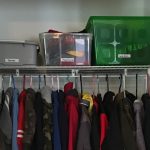 Label everything in enclosed containers. You know what is in that drawer now, but will you remember in a week? Labels allow you to
 shapes, try hooks on the wall or door. They will be easy to grab and just as easy to put away. Command hooks, if used properly, can be easily removed and reassigned as your needs change. You can even arrange the hooks in a row or circle or zigzag, whatever pattern is pleasant for your grouping and space.
 Decorate what you cannot hide. You are keeping it for now, but there isn’t a good place for it in storage. Try arranging it attractively in an empty corner. It will be pleasing to your eye while it occupies space until you use it again.
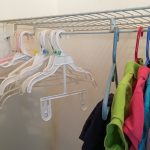 need to put the shirt back up right away…if they are always in the same place. Hunting through all your clothes for an empty hanger wastes time.
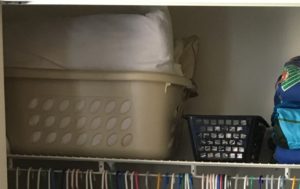
 We’ve all experienced the landslide effect; in addition to being unpleasant, that also takes time to put everything back where it belongs. Keep your stacks of boxes manageable, usually 3 or 4 high, so that you can pull one out without everything coming down on your head. If you need to go higher on a shelf, you can add extensions or make an open box function as a shelf.
 Repair as you go. Now is your chance. You are touching everything, so make needed repairs while you are sorting. Tape up broken boxes, replace ripped bags or cracked bins, etc.